
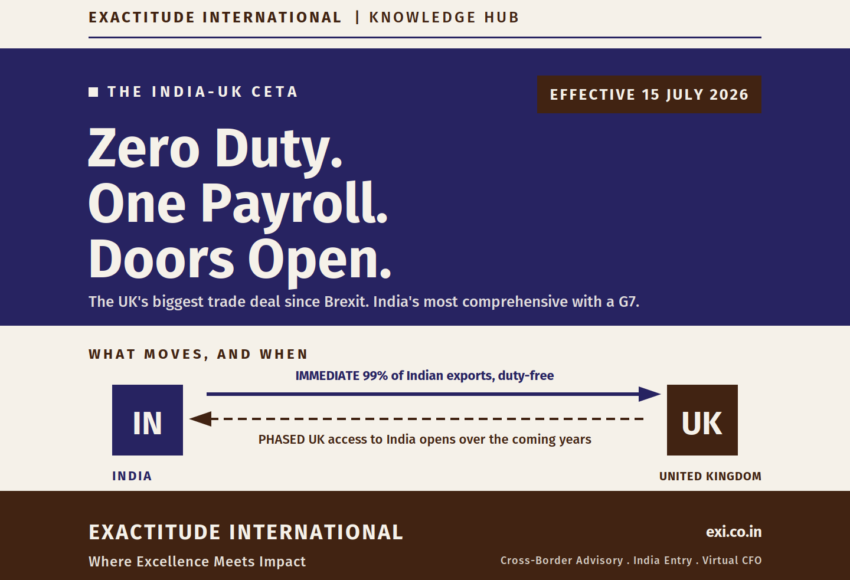
Zero Duty, One Payroll, Doors Open: The India-UK Deal Landing on 15 July
In under two weeks, the biggest shift in India-UK business in a generation goes live. Almost every Indian export enters Britain duty-free. Professionals stop paying social security twice. India opens its government contracts to British firms for the first time in history. Here is what actually changes, who gains first, and the three quiet traps that can cancel the savings before you ever see them.
EXI KNOWLEDGE HUB | JULY 2026
| AT A GLANCE ▪ What: The India-UK Comprehensive Economic and Trade Agreement (CETA), plus a Double Contribution Convention (DCC) on social security. ▪ Live from: 15 July 2026. Both texts are signed, ratified and confirmed. ▪ For India: Duty-free entry to the UK on 99 percent of exports, from day one. ▪ For the UK: Average tariff into India falls from about 15 percent to 3 percent, and Indian government contracts open to British firms for the first time. ▪ For people: No more paying social security in both countries, for assignments of up to five years. ▪ The catch: Most gains are phased over years, and none of them are automatic. |
On 15 July 2026, something unusual happens. A trade agreement stops being a headline and becomes a real bill of costs, a payroll decision, and a market that was shut swinging open. For anyone who moves goods, money or people between India and the United Kingdom, the rules they have worked under for years are about to change.
This is not a minor tweak. It is the United Kingdom’s most significant trade deal since leaving the European Union, and one of the most comprehensive India has ever signed. In plain terms, here is what it does.
Three years, fourteen rounds, one signature
The deal did not appear overnight. Its foundations were laid in May 2021, when the two governments announced an Enhanced Trade Partnership and set the ambition of doubling trade between them. Formal talks opened in January 2022.
What followed was one of the decade’s most closely watched negotiations: fourteen rounds across three years, repeatedly stalled by elections in both countries and by hard fights over whisky and car duties, a carbon border tax, professional mobility and social security. The text was finally concluded in May 2025 and signed in London on 24 July 2025. After an unusually quick ratification on both sides, the two governments fixed the start date: 15 July 2026.
Why this is not a normal trade deal
Most people picture a trade deal as a tariff cut. This one runs to thirty chapters, and tariffs are just one of them. The rest reach into places trade agreements rarely go. Three features make it genuinely different.
It ties social security to trade. Alongside the trade text sits a Double Contribution Convention that stops staff on temporary assignment from paying into two national systems at once. Very few trade deals carry an instrument like this.
It opens India’s government contracts to a G7 partner. India has long kept its public procurement closed. British firms now get defined access to Indian government contracts in transport, healthcare and energy, with published notices and a route to challenge unfair treatment. This is a first.
Its concessions are deliberately lopsided in timing. Indian exporters get near-immediate duty-free access to Britain. India’s tariff cuts on UK goods are phased in over years. That is a design choice, not an accident, and it decides how businesses should sequence their moves.
There is even a cultural signature in the fine print: a dedicated annual quota lets up to 1,800 Indian chefs, yoga instructors and classical musicians take up work opportunities in the UK each year, a people-to-people touch you almost never see written into a trade agreement.
What each side actually gains
Strip away the diplomacy, and the balance of the deal looks like this.
| WHAT INDIA GAINS | WHAT THE UK GAINS |
| ▪ Duty-free entry to the UK on 99 percent of tariff lines, effective immediately. ▪ Zero tariffs on labour-intensive exports: textiles and clothing, leather and footwear, marine products, processed food, engineering and auto components, chemicals and pharma. ▪ Access to 137 UK services sub-sectors and smoother, more predictable mobility for professionals. ▪ A long-run gain of roughly 5.1 billion pounds to GDP each year. | ▪ Average tariff into India cut from about 15 percent to 3 percent. ▪ 64 percent of UK products duty-free into India immediately, rising to 85 percent over time. ▪ First-ever access to Indian government contracts in transport, healthcare and energy. ▪ A long-run gain of about 4.8 billion pounds to GDP a year, plus 2.2 billion in higher wages. |
The catch is timing. India’s access to Britain is immediate. Britain’s access to India is mostly phased over several years. A business that assumes everything falls to zero on 15 July will price its decisions wrongly.
The quiet clause that saves the most money
Of everything in the package, the provision with the biggest immediate effect on cross-border employers is also the one most people miss: the Double Contribution Convention.
Until now, an Indian professional posted to Britain, or a Briton posted to India, could end up paying social security in both countries at the same time, with nothing extra to show for it. The DCC ends that. A worker on temporary assignment keeps paying into their home scheme alone.
The exemption now runs for five years, up from the three originally negotiated. The government expects more than 75,000 Indian professionals and over 900 companies to benefit. For a firm rotating staff across the corridor, that is a direct and recurring saving.
One warning: it is not automatic. To claim the exemption, the employer must obtain a Certificate of Coverage from the home authority, in India the Employees’ Provident Fund Organisation. The convention also coordinates contributions only. It does not hand over host-country benefits or pension rights, and assignments expected to run beyond five years fall outside it from day one.
The three traps between you and the savings
Here is the point the headline numbers hide.
A treaty does not deliver savings. Positioning against a treaty delivers savings.
The 25.5 billion pound trade figure and the 99 percent liberalisation are long-run, phased and, on the Indian side, spread over years. Three practical traps sit between the promise and the payoff.
1 Rules of origin: no paperwork, no discount.
Preferential tariffs apply only to goods that meet the origin rules and are documented correctly. UK exporters must register with HMRC through the Origin Registration portal; Indian exporters must set up their own origin self-certification. Miss it, and the goods pay the standard tariff. The saving simply disappears.
2 The DCC needs a certificate, not a wish.
The social security exemption is claimed, evidenced and administered, not granted by default. Payroll, tax-equalisation clauses and mobility policies all need revisiting before an assignment begins.
3 Investor protection is still unfinished.
The deal has no concluded investment chapter. A separate bilateral investment treaty is yet to be negotiated, so capital deployment and acquisitions across the corridor still run on domestic law and existing structures. For anyone timing an investment or a transaction, that gap is real.
This is exactly the point where tariff schedules, rules of origin, transfer pricing, FEMA and RBI compliance, social security certificates and India-entry structuring stop being separate boxes and become one sequenced strategy. Reading the treaty is the easy part. Turning it into a defensible commercial position, capturing the savings that land immediately, sequencing the ones that arrive later, and staying compliant in two jurisdictions at once, is the harder and more valuable work. It needs advice that sits across all of these at the same time, not in any single silo.
A few days, then a new rulebook
On 15 July 2026, the India-UK corridor does not just get cheaper. It gets a new rulebook. The businesses that gain the most will not be the ones that read the agreement first. They will be the ones that were positioned for it before it arrived.


Leave a Comment