
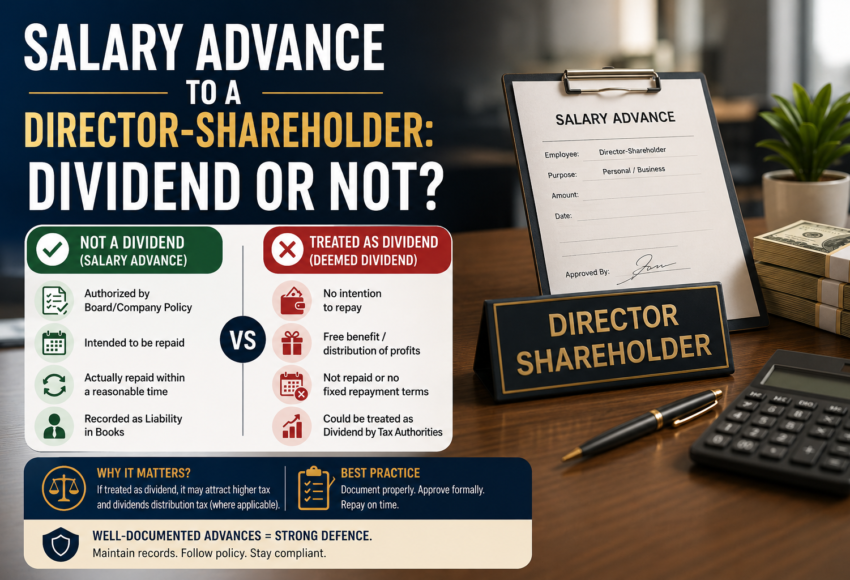
Salary Advance to a Director-Shareholder: Dividend or Not?
A closely held company advances salary to a director who also holds shares and draws a monthly package. Clean transaction, or a deemed dividend waiting to surface in assessment? A short Q&A on where the line actually sits.
1 Can a company give a salary advance to a director who is also a shareholder?
Yes, provided it is a genuine advance against salary that is recovered from future monthly salary within a short, reasonable period. The label “salary advance” is not self-certifying. Substance governs, not the wording of the ledger. A three-month advance recovered over three months is an advance. Twelve months of pay handed over at once with vague repayment is a loan.
2 When does a salary advance turn into a problem?
When it is a loan in disguise: large, disproportionate to salary, or left outstanding open-endedly. At that point two regimes engage. Section 185 of the Companies Act on the company law side, and Section 2(22)(e) of the Income Tax Act on the tax side, which is usually the sharper exposure.
3 What exactly is the deemed dividend risk?
If the director-shareholder beneficially holds 10 percent or more of the voting power, any loan or advance is treated as dividend in his hands, to the extent of the company’s accumulated profits, and taxed at slab rates. An interest-free advance also carries a separate perquisite charge under Rule 3(7)(i).
4 Is there case law that protects a genuine salary advance?
Yes. Salary accrues month to month and its drawal is not a distribution of accumulated profits. The wider principle is that only gratuitous advances, enjoyed purely by virtue of shareholding, fall within the section.
Shyama Charan Gupta v. CIT [2012] 337 ITR 511 (All). Pradip Kumar Malhotra v. CIT [2011] 338 ITR 538 (Cal). CIT v. Raj Kumar [2009] 318 ITR 462 (Del). CBDT Circular No. 19/2017 dated 12.06.2017.
5 Does the private company route offer any relief?
On the company law side, yes. A private company meeting the three conditions of the 5 June 2015 notification is outside Section 185 altogether. But that exemption is a company law shield only. It does nothing for Section 2(22)(e), which operates independently in the shareholder’s hands.
6 So how do I keep the file defensible?
Treat the advance as remuneration in advance, not as a facility. Tie it to salary, document the recovery, and let nothing material sit outstanding at year-end, where it surfaces in CARO reporting on related-party advances.
| DEFENSIBLE-FILE CHECKLIST | |
| Board resolution, or a uniform advance policy applicable to all employees. Quantum benchmarked to a defined number of months of salary. Written recovery schedule adjusted against monthly salary. | Reasonable interest where shareholding is 10 percent or more. Actual month-on-month adjustment, evidenced in payroll. Nothing material outstanding at the balance sheet date. |
| THE ONE LINE TO REMEMBER The case law protects the substance of a salary advance, not the label on the voucher. |


Leave a Comment