
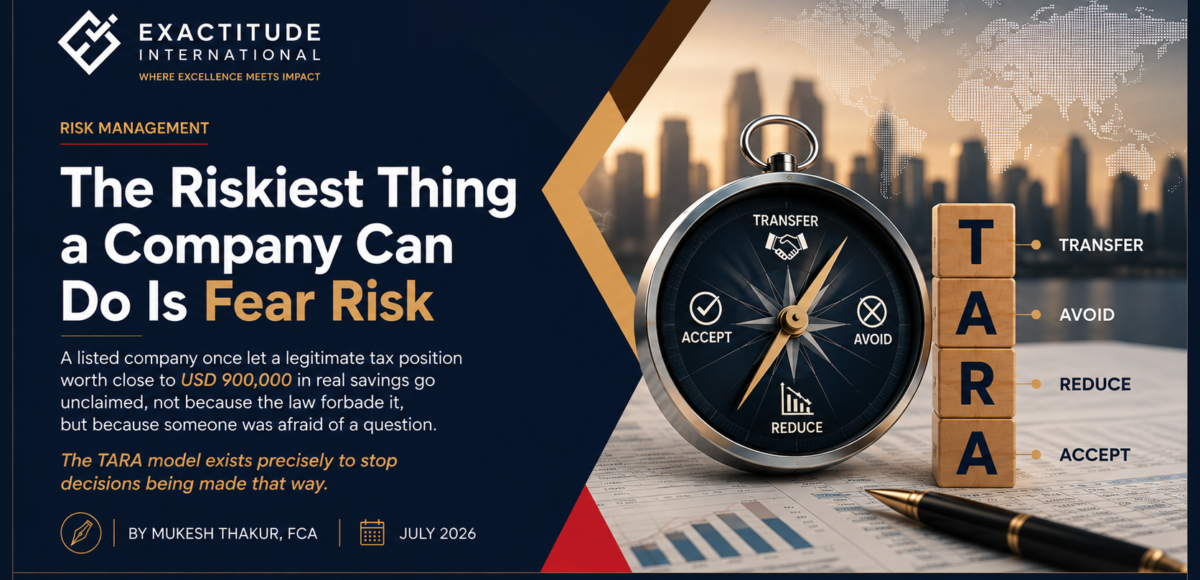
The Riskiest Thing a Company Can Do Is Fear Risk
A listed company once let a legitimate tax position worth close to USD 900,000 in real savings go unclaimed, not because the law forbade it, but because someone was afraid of a question. The TARA model exists precisely to stop decisions being made that way.
BY MUKESH THAKUR, FCA | JULY 2026
A few years ago, while working with a listed company, I watched a legitimate benefit stay exactly where it should not have: on the table. The claim itself was worth roughly Rs 25 crore, close to USD 3 million in deductions. At the company’s tax rate of about 30 percent, that translated into close to USD 900,000 in tax the company could simply have kept.
The country tax manager, while computing the year’s tax and effective tax rate, found a strong and entirely legitimate position in the company’s favour. Claiming it was straightforward. It would have improved cash flow, lifted returns for shareholders, and rested on solid ground. And yet it went unclaimed.
The reason was not law. It was fear. Claiming the benefit would have visibly lowered the effective tax rate against the previous year, and the manager was afraid the tax authorities would notice the difference and open a line of questions. So the apparently safer path, doing nothing, was chosen. Close to USD 900,000 in savings stayed unclaimed.
Read that again. The safe choice cost the company close to USD 900,000.
The most expensive risk is the one nobody records
This is the costliest kind of risk, because no one writes it down as a risk at all. We are trained to see risk in action: the new market, the acquisition, the bold hire. We rarely see it in inaction. But choosing not to claim a legitimate benefit is a risk decision too. It was simply made badly, by dread rather than by design.
The difference between companies that compound value and companies that quietly leak it is rarely intelligence or capital. It is how they respond to risk. Not whether they feel it, everyone feels it, but what they do next. That is exactly what the TARA model gives you: a way to respond to risk on purpose.
TARA: four ways to answer any risk
TARA stands for the four responses available to any risk: Transfer, Avoid, Reduce, Accept. Every risk your business meets, from a currency exposure to a disputed tax position to a dependence on one key person, can be met with one of these four, chosen deliberately.
Transfer. Move the risk to someone better placed to carry it, through insurance, hedging, indemnities, or outsourcing a process to a specialist. You still pay a price, the premium or the fee, but you convert an unpredictable loss into a known, budgeted cost.
Avoid. Step away from the activity that creates the risk. Exit a market, decline a client, discontinue a product. Avoidance is legitimate, but it carries a hidden cost, because you give up the reward that came with the risk. Avoid too often and you have simply chosen slow decline over visible danger.
Reduce. Keep the activity, but lower the likelihood or the impact through controls: better documentation, stronger processes, diversification, a second review. This is where most good risk work actually happens, and it is precisely the response the tax story was crying out for.
Accept. Consciously decide to carry the risk, because the cost of doing anything else is higher than the risk itself. The key word is consciously. Accepting a risk with open eyes is strategy. Accepting it by default, because you were too afraid to act, is not.
Replaying the decision with a framework
Now put the tax decision through TARA, and watch how differently it reads. The real risk was never the benefit. It was narrow: a query about the change in the effective rate and, at the very worst, the position being challenged later with interest. That single risk can be met by any of the four responses, and it is worth seeing all four, because three of them still let the company keep its USD 900,000.
Reduce. Claim the benefit, but lower the chance of a successful challenge. Prepare a thorough technical file, document the basis of the position, and disclose the reason for the movement in the effective rate proactively. A defensible claim, well papered, answers the query before it is even asked.
Transfer. Claim the benefit, but move the residual exposure onto someone else. A formal written opinion from independent counsel or a reputed firm shifts the technical judgment onto experts and, in most regimes, protects the company from penalty for taking a bona fide position. Where the stakes justify it, specific tax insurance can carry the financial exposure if the claim is later disallowed.
Accept. Claim the benefit, and consciously carry the small residual risk that a query arrives, because USD 900,000 plainly outweighs the manageable cost of answering questions on a position you believe is correct. This is acceptance with open eyes, which is a decision, not a gamble.
Avoid. Forgo the claim altogether to remove the risk of scrutiny entirely. This is legitimate only when the position is genuinely weak or the downside is severe. Here it was neither, which is why Avoid was the most expensive of the four responses. It was also, unfortunately, the one the company chose.
Notice what that reveals. Three of the four responses, Reduce, Transfer and Accept, keep the USD 900,000 and simply manage the risk in different ways. Only Avoid gives the money up. And the company did not even reason its way to Avoid. It froze, and freezing happens to look like Avoid from the outside. The failure was not choosing the wrong response. It was never truly choosing at all. A framework would not have made the decision brave. It would have made it a decision.
Fear is the most expensive line item a company never records.
Risk response is a daily habit, not a boardroom event
Here is the part most risk frameworks miss, and the part that matters most. Risk response is not something that happens once a year in a committee. It is a daily habit, formed in ordinary offices, in ordinary decisions.
The junior who flags an ambiguous clause instead of hoping it never surfaces. The finance lead who asks what we would do if this assumption is wrong before signing off, not after. The manager who treats a legitimate but unusual position as something to defend, not something to hide. These are TARA decisions, made a hundred times a week, long before any large risk ever arrives.
A company does not suddenly become good at risk when the stakes are high. It becomes good at risk through how it handles the small ones every day. Culture is just the sum of those small responses. If the everyday habit is fear, the big decision will be made in fear too.
Fear is the tax no one files
Which brings us to the quiet cost that never appears in any account. Fear shows up as the benefit not claimed, the market not entered, the price not raised, the honest disclosure not made. Leaders are often more afraid of being questioned than of being wrong, and so they optimise for the absence of questions rather than the presence of value.
What you see is not what it can be. The gap between the two is usually fear, wearing the costume of caution.
What good risk response unlocks
The inverse is where the real opportunity sits. A company that identifies its risks honestly and responds to them deliberately does not merely avoid losses. It moves faster than its more fearful competitors, because it is not paralysed by every unknown. It claims what is rightfully its own. It takes the calculated bets that others flinch from.
And the benefit does not stop at the balance sheet. A company that deploys its capital and claims its due strengthens its shareholders, invests and pays more, and adds to the economy around it. Handled well, good risk response is not just self-interest. It is one of the quiet engines of growth.
The point of the model
The tax manager was not incompetent. They were working without a framework, and so fear filled the space where a decision should have been.
That is what a model like TARA is for. Not to make anyone reckless, but to replace dread with a deliberate choice: transfer it, avoid it, reduce it, or accept it, with open eyes. The companies that build this habit, into their teams and into their everyday decisions, are the ones that stop leaving close to a million dollars on the table. The rest keep mistaking fear for prudence, and wondering why what they see is never quite what it could be.
EXACTITUDE INTERNATIONAL
Where Excellence Meets Impact
Audit and Assurance . Virtual CFO . Risk and Controls . Cross-Border Advisory . exi.co.in

Leave a Comment