
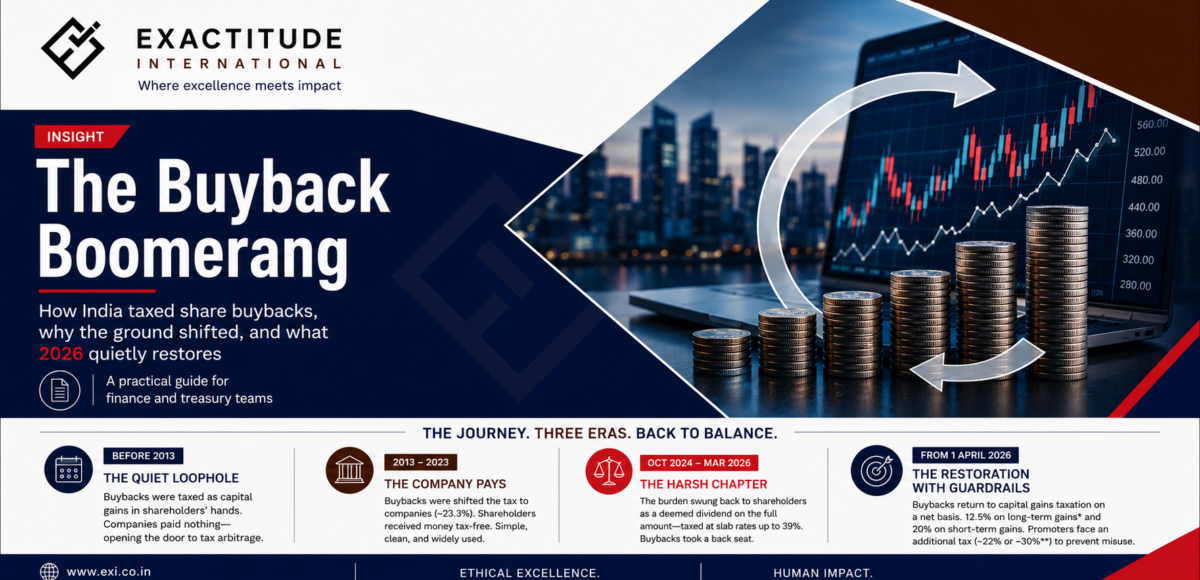
The Buyback Boomerang
How India taxed share buybacks, why the ground shifted, and what 2026 quietly restores
A practical guide for finance and treasury teams
In the last week of September 2024, an unusual thing happened in Indian boardrooms. Companies that had been sitting on buyback plans suddenly rushed to close them. Merchant bankers pulled late nights. The reason was not a market rally or an activist investor. It was a calendar. From 1 October 2024, the tax rules on buying back your own shares were about to flip, and everyone wanted to get in before the door shut.
That scramble is the clearest possible sign of how much tax design shapes corporate behaviour. A buyback is, in economic terms, simply a company returning surplus cash to shareholders by repurchasing and extinguishing shares. Whether that is a smart way to reward owners or an expensive mistake has, in India, depended less on the business logic and more on who holds the tax bill. Over roughly a decade, that answer has moved three times, and in 2026 it lands almost exactly where it started. Here is the full arc, and what it means going forward.
The position earlier: three distinct eras
Before 2013: the quiet loophole
Until 2013, a buyback was taxed as a capital gain in the shareholder’s hands. The shareholder paid tax only on the difference between the buyback price and what the shares had cost. The company itself owed nothing special. This was attractive, perhaps too attractive. Dividends at the time carried a Dividend Distribution Tax, so promoters and companies increasingly used buybacks as a lighter-taxed route to hand cash back, especially in closely held firms. The government saw revenue leaking and decided to act.
2013 to 2024: the company pays (Section 115QA)
The Finance Act 2013 introduced Section 115QA, a buyback distribution tax. The logic was to move the tax from the shareholder to the company. The company paid roughly 23.3% (a 20% base plus 12% surcharge and 4% cess) on the distributed income, and the shareholder received the money completely tax-free under Section 10(34A). Initially this applied only to unlisted companies. In 2019 it was extended to listed companies as well, closing the last gap.
For investors this was close to ideal: cash arrived with no tax to pay. For companies it was a flat, sizeable cost, but a simple one. Cash-rich firms, particularly in IT, leaned heavily on buybacks. The likes of TCS, Infosys and Wipro returned tens of thousands of crores this way, partly because it was cleaner than dividends and signalled confidence in the share price.
October 2024: the harsh middle chapter
The Finance (No. 2) Act 2024 tore this up. From 1 October 2024, Section 115QA was scrapped and the burden swung back to the shareholder, but in a far heavier form than before 2013. The entire buyback amount was now treated as a deemed dividend and taxed at the shareholder’s slab rate, which for many individuals meant close to 39%. Crucially, the cost of the shares could not be set off against that dividend. Instead it became a separate capital loss, useful only if you had other capital gains to absorb it.
Read that again, because it is the crux. You were taxed on the whole receipt, not on your profit. An investor who bought at Rs 950 and tendered at Rs 1,000 was taxed as if the full Rs 1,000 were income. In some cases the tax exceeded the actual economic gain. KPMG later called the journey a merry-go-round; for shareholders in this phase it felt more like a penalty. Predictably, buyback activity cooled and many boards switched to ordinary dividends, since the tax treatment had effectively converged.
What 2026 restores
The Finance Act 2026 is, in effect, a course correction. From 1 April 2026, the deemed-dividend treatment (the sub-clause inserted into the definition of dividend in 2024) is removed, and buybacks return to capital gains taxation on a net basis. The shareholder is taxed only on the gain, that is the buyback price minus the cost of acquisition, exactly as with a normal sale of shares. For listed equity that means 12.5% on long-term gains (above the Rs 1.25 lakh annual exemption) and 20% on short-term gains. This is essentially the pre-2013 world brought back, which is why practitioners describe it as a restoration.
There is, however, an important twist, and it is worth understanding rather than glossing over. The restoration is not unconditional for promoters. To stop controlling shareholders from using buybacks purely as a low-tax way to pull cash out of the company, the Act adds a special additional tax on promoter shareholders. The effective burden on them is pushed to about 22% where the promoter is a domestic company and about 30% for other promoters, with a surcharge applying on that additional levy. This extra tax attaches to buybacks carried out under Section 68 of the Companies Act, that is buybacks by Indian companies. A promoter here is read through the SEBI Buy-back Regulations for listed companies, or through the Companies Act definition and a more than 10% shareholding test for others.
So the honest summary is: 2026 restores the shareholder-friendly capital gains regime for the ordinary investor, while keeping a targeted higher rate on promoters. It is a restoration with guardrails, not a clean rewind.
The two regimes side by side
| Feature | Oct 2024 to Mar 2026 (Dividend regime) | From 1 April 2026 (Capital gains regime) |
| Who is taxed | The shareholder | The shareholder |
| Nature of income | Deemed dividend on the full amount received | Capital gain on the net amount (price minus cost) |
| Cost of acquisition | Not deductible against the dividend; allowed only as a separate capital loss | Fully deductible from the buyback consideration |
| Rate for non-promoters | Slab rate, up to about 39% for individuals | 12.5% long-term or 20% short-term for listed shares |
| Extra load on promoters | None specific; same slab treatment | Additional tax taking the burden to about 22% (promoter companies) or 30% (others) |
| Effect for retail investor | Harsh: tax on gross receipt | Concessional: tax only on the actual gain |
The same buyback, before and after
Take an investor holding 100 listed shares bought at Rs 700 each, tendered in a buyback at Rs 1,000 each, held long term.
| Same buyback, two regimes | Dividend regime | Capital gains regime |
| Shares tendered | 100 | 100 |
| Cost when bought (Rs 700 each) | Rs 70,000 | Rs 70,000 |
| Buyback price (Rs 1,000 each) | Rs 1,00,000 | Rs 1,00,000 |
| Amount treated as income | Rs 1,00,000 (dividend) | Rs 30,000 (gain) |
| Tax outgo (illustrative) | About Rs 35,000 at 30% slab | Rs 3,750 at 12.5% |
Same transaction, same cash in hand, but the tax outgo falls from roughly Rs 35,000 to Rs 3,750. That gap is the whole story of why 2026 matters.
How this affects companies
The headline is that buybacks become an attractive tool again, but the incentive is now split by shareholder type, and that changes the calculus in the boardroom.
For companies with a broad base of retail and institutional owners, the case for buybacks strengthens sharply. A public shareholder now pays 12.5% on the gain rather than up to 39% on the gross amount, which makes a buyback a genuinely tax-efficient way to return surplus cash and support the share price. Expect cash-rich sectors, IT services above all, to revisit buybacks as a serious alternative to dividends, where the payout is still taxed at slab rates. When a company has to choose between the two, the buyback route is once again the cheaper one for the receiving shareholder.
For promoter-heavy and family-run companies the story is more muted. The additional 22% or 30% charge on promoters deliberately removes the arbitrage that made buybacks so tempting for controlling owners. A promoter tendering into a buyback will find the tax advantage largely neutralised, so the decision has to rest on genuine capital-allocation logic rather than tax engineering. This is by design, and boards with concentrated ownership should model the promoter tax before announcing anything.
Two practical cautions are worth flagging. First, the more than 10% test for who counts as a promoter is a blunt instrument. A large institutional investor with no board seat and no control could be swept into the higher rate simply by crossing that threshold, so read the fine print before assuming ordinary capital gains rates apply. Second, treasury teams should expect timing behaviour around the 1 April 2026 switch, much like the September 2024 rush, and should not read a spike or lull in buyback announcements as a real shift in corporate confidence.
There is also a cross-border angle. Because the income is now a capital gain rather than a dividend, non-resident shareholders may be able to invoke favourable capital gains articles in tax treaties, something that was harder under the dividend regime. For companies with meaningful foreign holding, that can widen the appeal of a buyback further.
The takeaway
India’s buyback tax has travelled a full loop: capital gains before 2013, a company-level tax through 2024, a punishing dividend regime for eighteen months, and now, from April 2026, back to capital gains for most shareholders with a special charge reserved for promoters. For finance teams the practical message is simple. The buyback is once again a legitimate, tax-efficient lever for returning cash, provided you check who is on the other side of the transaction. For the ordinary investor it is unambiguously good news. For the promoter it is a reminder that the tax authorities have seen this film before and have kept one hand on the guardrail.
Note: Rates and thresholds are illustrative and simplified for readability; surcharge and cess vary by shareholder profile. Confirm the exact position with a tax adviser before acting on a specific buyback.


Leave a Comment