
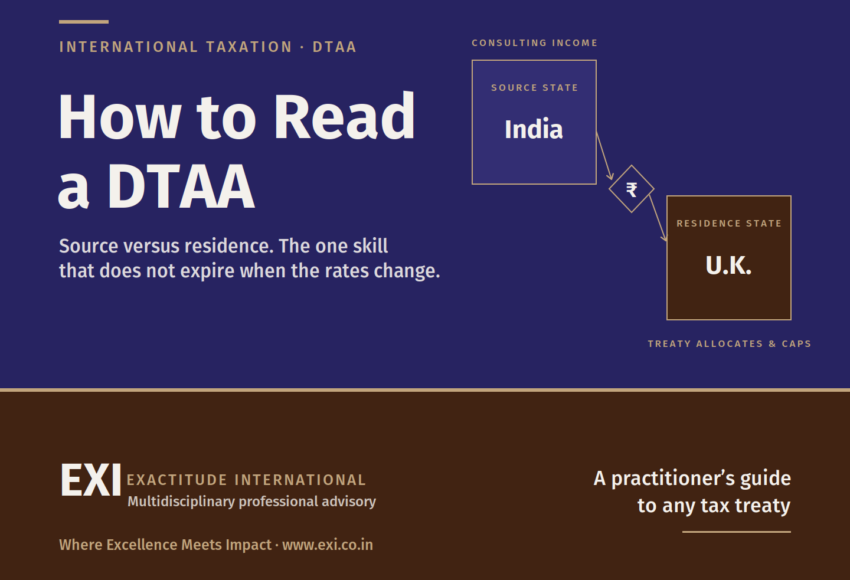
You Can Read a 40-Page Tax Treaty in 20 Minutes. Here Is How.
A client once forwarded me a single line from his UK consultant: “Deduct 20% TDS on the payment to our invoice, treaty or no treaty.”
Most interns would do the obvious thing. Rush to the DTAA, press Control+F, find the keyword, and read off whatever rate sits next to it. Whatever it says becomes the verdict.
The payment was 80 lakh. The 20% came to 16 lakh. The correct treaty rate was zero, because the income was not taxable in India at all. Nobody had read the treaty. They had read the fear of getting it wrong.
There is a particular style in which every DTAA is written. Once you know its architecture, and you have the skill to read it, you can hold your own with any treaty between any two countries. This article covers the essential skill that every finance and accounts professional should have for moments like these, because you are usually asked for the answer on the spot, with the payment already overdue.
That is the strange thing about Double Taxation Avoidance Agreements. Everyone respects them. Almost nobody reads them. They sit on the income tax website, ninety of them for India alone, each one a dense bilateral contract written in the flat, recursive language of international law, and most professionals treat them the way they treat a fire extinguisher. Good to know it exists. Hope I never have to actually use it.
I want to change that for you in one article. By the end of this, you will not have memorised the India-UK treaty. Something more useful will have happened. You will know how to open any DTAA, find the article you need, and read it correctly. That skill does not expire when the rates change. It is the difference between charging a client for an opinion and charging them for a guess.
Let us build it from the ground up.
First, why does this document exist at all?
Imagine you are a UK company. You earn 1 crore of consulting income from an Indian client. India says: this income arose in our country, so we will tax it. The UK says: you are our resident company, your worldwide income is ours to tax, so we will tax it too.
Same income. Two countries. Two tax bills. This is juridical double taxation, and left alone, it would strangle cross-border business. No company would export a service if two governments each took a full bite of the same income.
A DTAA is the treaty that two countries sign to divide that income in an agreed way. It does not create new tax. It is not a tax law. It is an allocation agreement. It decides, income type by income type, which country gets to tax, which country has to step back, and what happens when both still want a piece.
Hold on to that idea, because it explains the entire structure of every treaty you will ever read. A DTAA is not asking “how much tax?” It is asking “whose tax?”
In India, the treaty gets its legal force from Section 159 (earlier Section 90 of the Income Tax Act, 1961). And it contains one of the most taxpayer-friendly rules in the entire Act: where a DTAA applies, the taxpayer gets whichever is more beneficial, the treaty or the domestic law. The treaty can reduce your Indian tax. It can never increase it. That single rule is why reading the treaty is always worth your time. The downside is zero.
The five words that unlock everything
Before you read a single article, you need five terms. Treaties are written in a private vocabulary, and once you have it, the fog clears.
Contracting State. This just means “one of the two countries that signed.” In the India-UK treaty, the two Contracting States are India and the United Kingdom. That is all it means. Do not let the formality intimidate you.
The other Contracting State. Treaties are written symmetrically, so instead of naming countries, they say “a Contracting State” and “the other Contracting State.” When you read it, mentally plug in the names. If your client is the UK resident earning income in India, then for your purposes “the other Contracting State” is India, the place the money came from. Read every article twice if you must, once with India as “the State” and once with the UK, until the symmetry stops confusing you.
Resident. This is the gatekeeper. A DTAA is available only to a resident of one of the two countries. If your client is not a tax resident of either India or the UK, the India-UK treaty does nothing for them, no matter how much income flows between the two countries. Residence is the entry ticket. We will look at how it is determined in a moment, because it is where most mistakes begin.
Source State and Residence State. Every cross-border income has two ends. The Source State is where the income arises (India, in our consulting example, because that is where the client paid from). The Residence State is where the earner lives or is incorporated (the UK). The whole treaty is a negotiation between these two roles. Source wants to tax because the money was made on its soil. Residence wants to tax because the earner belongs to it. The articles tell you who wins, for each kind of income.
That is the vocabulary. Source versus residence is the central tension of the entire document. Keep asking yourself: in this transaction, who is source and who is residence? Get that right and half the work is done.
Residence: the gate everyone walks past
Here is where careful reading earns its money.
A person can be a resident under Indian domestic law and still not get treaty protection, or can be claimed as resident by both countries at once. The treaty has a rule for this, and it is called the tie-breaker.
Picture an individual who spends part of the year in India and part in the UK. Both countries, applying their own domestic rules, declare them a resident. Two residences, one person. The treaty cannot allow that, because residence decides who taxes worldwide income. So Article 4 runs a cascade, a series of tests applied in strict order, until one country wins:
First, where is their permanent home? If they have a home available to them in only one country, that country wins, and you stop. If they have a home in both, you move down.
Then, where is their centre of vital interests, their family, their economic life, their social roots? Whichever country those tilt toward wins.
If that is still unclear, where is their habitual abode, where do they actually spend their time? Then nationality. And if all else fails, the two governments decide by mutual agreement.
The order matters. You do not pick the test you like. You start at the top and go down only when a test fails to break the tie. For companies, the typical tie-breaker historically was place of effective management, where the real decisions get made.
This is exactly where a UK company can lose its treaty. India introduced its own place-of-effective-management test in domestic law. So a UK-incorporated company whose board actually runs the business from a Delhi office could be treated as Indian-resident, and then it cannot turn around and claim benefits as a “UK resident.” The treaty is gone, and the company never noticed, because nobody read Article 4 before reading the article they wanted.
The practical lesson: never reach for a substantive article until you have established residence. And in India, residence claims need a Tax Residency Certificate (TRC) from the other country’s tax authority, plus Form 41 (earlier Form 10F) where the certificate is incomplete. Without the paper, the benefit is contestable no matter how clearly the treaty supports you.
The map of any treaty (this is the part to screenshot)
Every DTAA, whether it follows the OECD Model or the UN Model, is built on the same skeleton. Once you can see the skeleton, you can find anything in any treaty in under a minute.
It runs in four blocks.
Block 1, Scope and Definitions (roughly Articles 1 to 5). This is the “who and what” section. Who does the treaty cover (residents)? Which taxes does it cover (income tax, corporation tax, capital gains tax, but not GST or stamp duty)? What do the key terms mean? And critically, what is a Permanent Establishment (Article 5), the fixed base or agent that lets the source country tax a foreign company’s business profits? PE is the trip-wire of international tax. No PE, usually no source-country tax on business profits. A PE, and the profits attributable to it become taxable in the source country.
Block 2, the Distributive Rules (roughly Articles 6 to 22). This is the engine room, the part you will actually use. Each article takes one type of income and rules on who taxes it. Business profits, dividends, interest, royalties, fees for technical services, capital gains, salary, pensions, each gets its own article. This is where you spend your time.
Block 3, the Relief Method (roughly Articles 23 to 24). Even after the rules divide the taxing rights, the same income can still be taxed twice in shared cases. So the residence country promises relief, usually by giving a credit for tax paid in the source country. India almost always uses the credit method, not exemption.
Block 4, the Administrative and Anti-Abuse articles (roughly Articles 25 onward). Non-discrimination, the Mutual Agreement Procedure for disputes, Exchange of Information, and the modern anti-avoidance rules. These protect the integrity of the treaty.
That is the whole architecture. Scope, then who-taxes-what, then relief, then administration. Open any treaty in the world and you will find these four blocks in this order. The article numbers shift by a digit or two, but the logic never moves.
Reading a single article correctly
Now the technique itself, because the distributive articles are where money is won and lost.
Take a payment of royalty from an Indian company to a UK company. You want to know what India can charge.
Step one, characterise the income. This is the most important and most-skipped step. What is this payment? Is it a royalty? A fee for technical service? Business profit? The same money can fall under different articles depending on its true nature, and each article has different rules. A payment for off-the-shelf software, for instance, was long argued to be a royalty until the Supreme Court clarified that a mere right to use a product, with no transfer of copyright, is not a royalty at all. Get the character wrong and every step after it is wrong.
Step two, find the governing article. Specific beats general. If the income is a royalty, the royalty article governs, not the general business-profits article. Income only falls into the residual “Other Income” article if no specific article claims it.
Step three, and this is the habit that separates careful readers, read both paragraphs of the article. Distributive articles almost always have two parts. The first paragraph grants a taxing right. The second restricts it. The royalty article will say India may tax the royalty (paragraph one), but then cap that tax at a fixed percentage (paragraph two), and then add a condition: the cap applies only if the UK recipient is the beneficial owner of the income. If a UK shell company is just passing the money through to someone in a third country, it is not the beneficial owner, and the cap evaporates. Readers who stop at paragraph one miss the condition that decides the case.
Step four, compare with domestic law and take the better deal. Apply Section 159 (earlier Section 90(2)). If the domestic rate is lower than the treaty cap, use the domestic rate. The treaty is a floor on your benefit, never a ceiling.
Four steps. Characterise, locate, read both paragraphs, compare. Run them in order, every time, and you will be reading treaties more carefully than most people who have been doing it for a decade.
The twist nobody told you: the treaty text on the website is out of date
Here is the part that catches even experienced professionals.
The treaty PDF you download is often the original text. But since 2017, a single instrument has quietly rewritten large parts of nearly every Indian treaty at once. It is called the Multilateral Instrument (MLI), and it is the delivery mechanism for the OECD’s BEPS project, the global effort to stop profit-shifting and treaty abuse. India’s MLI took effect in October 2019. The UK signed too. So the India-UK treaty you read today is the original text as modified by the MLI, and the original PDF does not show those modifications.
The most important change the MLI brought is the Principal Purpose Test (PPT). In plain language: if it is reasonable to conclude that one of the main reasons a transaction was structured the way it was, was simply to grab a treaty benefit, the benefit can be denied. It does not matter that you followed the treaty text to the letter. If the structure has no real commercial purpose beyond the tax saving, the PPT can switch the benefit off.
This is a profound shift. The old game was “comply with the words.” The new game is “comply with the words and have a genuine business reason.” For anyone building holding structures or routing investments, the lesson is to document the commercial logic at the time, not invent it later under audit.
So the modern reading method has a fifth step that sits between locating the article and concluding: check the MLI overlay. The OECD publishes a “synthesised text” for each treaty, the original article rewritten to show the MLI’s effect. Use that, not the raw 1993 PDF. And remember that the MLI only changes a treaty where both countries adopted matching positions, so verify the match before you rely on it.
There is one more trap worth naming. India’s treaties often carry a Most Favoured Nation clause, a promise that if India later gives a better rate to some other country, this treaty gets that better rate too. It sounds automatic. It is not. The Supreme Court has held that the MFN benefit needs a specific government notification to take effect. So check for the notification before you promise a client the lower rate. The clause alone is not enough.
What you can now do
Put it together and you have a repeatable method that works on any of the ninety-plus treaties India has signed, and on treaties between any two countries in the world:
Establish residence first, because it is the gate. Identify who is the source country and who is the residence country, because that tension drives everything. Characterise the income honestly, because the character decides the article. Find the specific article, and read both paragraphs, because the second one holds the conditions. Apply the MLI overlay, because the website text is stale. Then compare with domestic law and take whichever is kinder to the taxpayer.
That is not memorisation. That is a skill. It does not care whether the rate is 10% or 15%, whether the country is the UK or Singapore or the Netherlands, whether the year is 2026 or 2036. The numbers change. The method does not.
The consultant whose 16 lakh was nearly deducted in error got his payment in full, with nil withholding, because someone finally opened the treaty and read it in the right order. The treaty had always said so. It just needed reading.
The document is not a fire extinguisher. It is a map. And you can read it now.
Mukesh Thakur is a Fellow Chartered Accountant (FCA) with ACCA credentials and IFRS specialisation, and the Founder and Managing Partner of Exactitude International Private Limited (EXI), a multidisciplinary professional advisory firm headquartered in New Delhi. EXI advises on international tax, India entry, transaction advisory, IFRS and Ind AS, ESG reporting, and virtual CFO engagements.
www.exi.co.in | Where Excellence Meets ImpactThis article is for educational purposes and does not constitute legal or tax advice. Treaty positions change through amendment, court rulings, and circulars. Seek specific professional advice for your situation.


Leave a Comment