
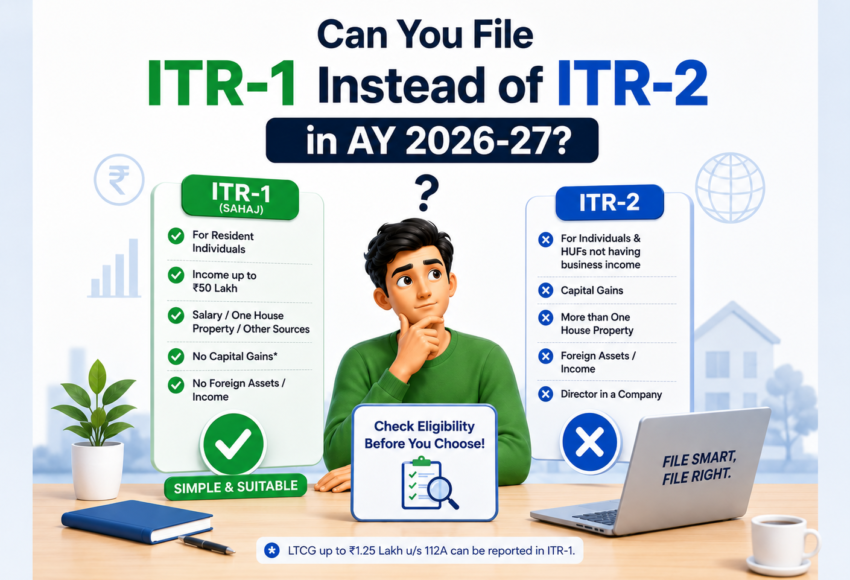
Can You File ITR-1 Instead of ITR-2 in AY 2026-27?
Choosing the correct Income-tax Return (ITR) form is one of the most important aspects of tax compliance. Filing an incorrect return can lead to processing delays, defective return notices, or even the requirement to file a revised return.
For Assessment Year (AY) 2026-27, the Income-tax Department has introduced a significant relaxation in the eligibility conditions for ITR-1 (Sahaj). As a result, many salaried taxpayers who were previously required to file the relatively detailed ITR-2 may now be eligible to file the simpler ITR-1.
What Has Changed?
Until the previous assessment year, the existence of any capital gains, irrespective of the amount, generally rendered a taxpayer ineligible to file ITR-1. Consequently, even salaried individuals with a small amount of long-term capital gains (LTCG) from listed equity shares or equity-oriented mutual funds had to file ITR-2. For AY 2026-27, this position has been relaxed.
Resident individuals can now file ITR-1 even if they have Long-Term Capital Gains (LTCG) under Section 112A up to ₹1.25 lakh, provided all the prescribed conditions are satisfied.
Who Can Benefit?
The relaxation primarily benefits salaried individuals and pensioners who have straightforward income profiles but also earn modest long-term capital gains from investments such as:
- Listed equity shares
- Equity-oriented mutual funds or
- Units of a business trust covered under Section 112A.
Earlier, these taxpayers were compelled to use ITR-2 despite having otherwise simple tax affairs. They may now be able to continue using the significantly simpler ITR-1.
Eligibility Conditions Continue to Apply
The relaxation is not universal. A taxpayer can use ITR-1 only if the prescribed eligibility conditions are satisfied, including:
- Resident individual status
- Total income not exceeding ₹50 lakh
- Income from salary or pension
- Income from not more than two house properties
- Income from other sources such as interest (excluding specified categories)
- Agricultural income not exceeding ₹5,000 and
- Long-term capital gains under Section 112A not exceeding ₹1.25 lakh without complex capital gain reporting requirements or carried-forward capital losses.
When Will ITR-2 Still Be Required?
Despite the relaxation, many salaried taxpayers will continue to require ITR-2. Examples include taxpayers having:
- Long-term capital gains exceeding ₹1.25 lakh under Section 112A
- Short-term capital gains
- Capital gains from sale of property or other assets
- Capital loss to be carried forward or set off
- Foreign assets or foreign income
- Directorship in a company
- Investments in unlisted equity shares or
- Any other income that falls outside the scope of ITR-1.
Why the Relaxation Matters
The amendment is expected to reduce the compliance burden for a large number of salaried taxpayers.
ITR-1 is considerably simpler than ITR-2, requiring fewer schedules and disclosures. Allowing eligible taxpayers with limited LTCG under Section 112A to continue using ITR-1 makes the return filing process more efficient without compromising reporting requirements.
Practical Points Before Filing
Before selecting ITR-1, taxpayers should carefully review their income profile for the entire financial year. In particular, they should verify:
- Whether the capital gains are exclusively covered under Section 112A.
- Whether the aggregate LTCG remains within the prescribed ₹1.25 lakh limit.
- Whether any capital losses are required to be carried forward.
- Whether any foreign assets, foreign income or other disqualifying conditions exist.
- Whether all other eligibility conditions for filing ITR-1 continue to be satisfied.
Choosing an incorrect return form may result in avoidable notices and delays in processing.
Conclusion
The relaxation in the eligibility conditions for ITR-1 is a welcome measure for salaried taxpayers with relatively simple investment portfolios. By permitting reporting of limited long-term capital gains under Section 112A within ITR-1, the Income-tax Department has reduced the compliance burden for many individuals who previously had no option but to file ITR-2.
However, taxpayers should not assume automatic eligibility. The availability of ITR-1 continues to depend upon satisfying all the prescribed statutory conditions. A careful review of the nature of income, capital gains, and disclosure requirements remains essential before selecting the appropriate return form for AY 2026-27.


Leave a Comment