
AI Governance for Businesses: Opportunity Without Compliance Blind Spots
Decades ago, Isaac Asimov imagined a world where intelligent machines followed three simple rules.
- First, a machine must never harm a human.
- Second, it must follow instructions, unless those instructions cause harm.
- Third, it must protect its own existence, as long as it does not conflict with the first two.
Simple rules. Clear priorities.
People come first. Process comes next. Survival comes last. Basically People (Life) > Process (Rules) > Profit (Sustenance).
Today, businesses are building and deploying AI systems that make decisions, influence outcomes, and shape experiences. But unlike Asimov’s fictional world, these systems are not naturally governed by such principles.
That is where the challenge begins.
AI creates speed, efficiency, and scale. But without clear boundaries, it can also create risks that are difficult to detect until it is too late.
This is why AI governance is no longer optional. It is essential.
The Double-Edged Nature of AI
AI is no longer a future ambition. It is already shaping how businesses hire, sell, manage risk, and make decisions.
But here is the challenge: The same AI that helps you move faster can also expose you to risks you did not anticipate.
Imagine a growing company using AI to screen candidates. It saves time and improves efficiency. Months later, they discover the system has been unintentionally biased. Now the issue is not operational. It is legal, reputational, and ethical.
AI creates opportunity. But without governance, it also creates blind spots.
What AI Governance Really Means
AI governance is often seen as complex or technical. It is neither. At its core, it means ensuring that the way your business uses AI is responsible, transparent, and aligned with both regulations and values.
A simple way to understand it is to compare it with financial controls.
You would not allow money to move through your business without checks, visibility, and accountability. AI should be treated the same way.
Strong governance answers simple but critical questions:
- Who is responsible for AI-driven decisions?
- Can we explain how the AI reached a conclusion?
- Are we using data ethically and legally?
- What happens if something goes wrong?
If these questions do not have clear answers, there is a governance gap.
The Real Opportunity: Trust as a Business Advantage
Many businesses see governance as a restriction. In reality, it is an enabler.
Consider two companies offering similar AI-driven services.
One cannot clearly explain how its AI works. The other can demonstrate fairness, transparency, and accountability.
- Which one will customers trust more?
- Which one will regulators be more comfortable with?
- Which one will scale with fewer disruptions?
The second company does not just reduce risk. It builds a long-term advantage.
Trust is becoming a deciding factor in how AI is adopted and scaled.
Where Businesses Get It Wrong
Most AI risks do not come from bad intent. They come from overlooked gaps.
- Treating AI as just another tool: AI is not traditional software. It learns and evolves, which makes outcomes less predictable.
- Lack of ownership: When everyone uses AI but no one owns it, accountability disappears.
- Ignoring data risks: AI reflects the quality of the data it is trained on. Biased or incomplete data leads to flawed outcomes.
- Compliance as an afterthought: Many businesses only think about regulation when something goes wrong. By then, the cost is already high.
These are not technical failures. They are governance failures.
Building AI Governance Without Slowing Down Innovation
Effective governance does not need to be heavy. It needs to be clear and practical.
- Start with clarity: Identify where AI is being used, what decisions it influences, and what risks are involved.
- Assign ownership: Every AI system should have a clearly defined owner responsible for its outcomes.
- Focus on explainability: If you cannot explain how your AI works in simple terms, you should not fully rely on it.
- Introduce ethical checkpoints: Before deployment, ask:
- Is this fair?
- Is this transparent?
- Would we stand by this decision if it were publicly reviewed?
- Monitor continuously: AI systems evolve. Governance should evolve with them.
The Regulatory Reality
AI regulation is no longer a future concern. It is already taking shape across multiple jurisdictions.
For businesses, this means:
- Expectations around compliance will increase
- Transparency and documentation will become essential
- Lack of awareness will not protect against consequences
There is also a broader shift. Regulation reflects what society expects from businesses using powerful technologies. Governance helps bridge that expectation.
Businesses that prepare early will adapt with confidence. Those that delay will respond under pressure.
The Evolving Landscape of AI Governance: India and Beyond
AI governance is not being built in isolation. Governments and institutions across the world are actively defining how AI should be developed and used.
Globally, there is a clear shift toward responsible AI.
For example, the European Union has introduced the EU AI Act, which classifies AI systems based on risk and places stricter obligations on high-risk applications.
In the United States, frameworks such as the NIST AI Risk Management Framework provide guidance on managing AI risks through structured processes and accountability.
In India, the approach is evolving with a focus on innovation balanced with responsibility. Initiatives from NITI Aayog and guidance under the Digital Personal Data Protection Act, 2023 signal a growing emphasis on ethical data use, privacy, and accountability in AI systems.
While these frameworks differ in structure, they share common themes:
- Transparency in how AI systems operate
- Accountability for outcomes
- Protection of individuals and their data
- Risk-based oversight
For businesses, the message is clear.
AI governance is not just an internal priority. It is becoming a regulatory expectation.
Organizations that align early with these principles will not only reduce compliance risk, but also build systems that are more resilient, trustworthy, and scalable across markets.
Governance as a Foundation for Sustainable Growth
AI is one of the most powerful tools available to businesses today. But power without structure creates risk. AI governance is not about limiting innovation. It is about ensuring that innovation is responsible, scalable, and trusted. The businesses that succeed with AI will not be the ones that move the fastest. They will be the ones that move with clarity, accountability, and intent.
In the long run, opportunity without governance is not opportunity, it is exposure.
AI is one of the most powerful tools available to businesses today. But power without structure creates exposure. The question is not whether your business will use AI. It is whether you will use it with clarity and control.
Decades ago, Isaac Asimov’s three laws placed one principle above all else. Technology must not harm people. Everything else follows from that. He certainly was onto something.
For businesses today, the lesson is just as relevant. AI governance is not about slowing innovation. It is about ensuring that innovation respects a clear order of priorities.
- People first.
- Process next.
- Then performance and scale.
When that order is clear, AI becomes not just a tool for growth, but a foundation for trust. And in the long run, trust is what sustains both innovation and success.
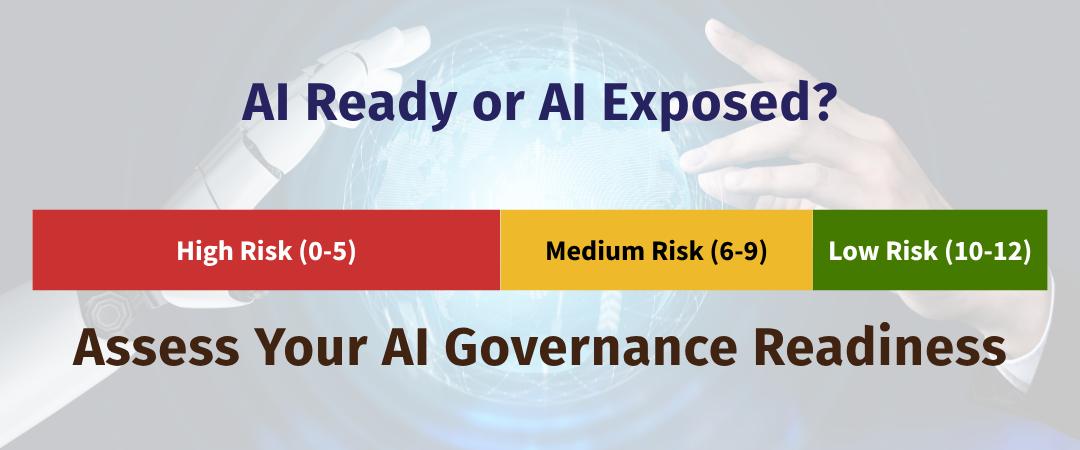
Most businesses believe they are using AI responsibly. Few have actually tested it.
Download the AI Governance Readiness Quiz to assess where you stand.

Leave a Comment