
Why No TDS on Your Salary Doesn’t Always Mean No Income Tax
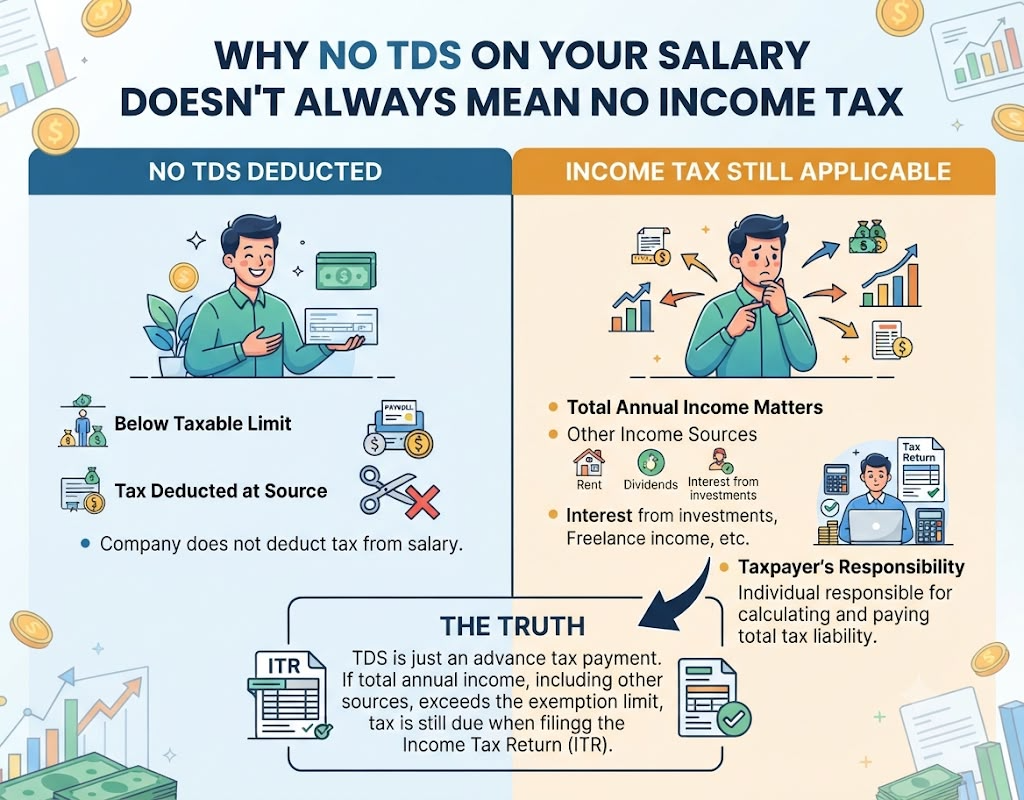
As the Income-tax Return (ITR) filing season for Assessment Year 2026-27 gathers pace, many salaried taxpayers are surprised to discover that the absence of Tax Deducted at Source (TDS) on their salary does not necessarily mean they have no income tax liability.
This misconception largely stems from the enhanced rebate available under Section 87A of the Income-tax Act under the new tax regime and the corresponding reduction in TDS by employers. While many employees received their salaries throughout the financial year without any tax deduction, the computation of TDS and the determination of final tax liability operate on entirely different principles.
Understanding this distinction is crucial to avoid unexpected tax demands, interest liability, and last-minute surprises while filing the Income-tax Return.
The tax deduction at source (TDS) provisions have led many salaried taxpayers to believe that annual salary up to ₹12 lakh is now completely exempt from income tax. This misconception has gained traction because employers may no longer be required to deduct TDS in certain cases.
However, absence of TDS should not be equated with absence of tax liability.
TDS is merely a mechanism for collection of tax during the financial year. It neither determines nor extinguishes the actual income tax payable by the employee. The final tax liability continues to be determined only at the time of filing the Income-tax Return (ITR).
Understanding the Difference Between TDS and Income Tax
Tax Deducted at Source (TDS) is a method of collecting income tax in advance. Employers deduct tax from salary based on the estimated taxable income of an employee and deposit the same with the Government.
The Income-tax Return, on the other hand, determines the taxpayer’s actual liability after considering:
- Salary income.
- Income from other sources.
- Capital gains.
- House property income.
- Eligible deductions and exemptions, wherever applicable.
- Tax rebate, surcharge and cess.
Accordingly, even where no TDS has been deducted, tax may still become payable at the time of filing the return if the total taxable income exceeds the applicable limits or if the taxpayer does not satisfy the conditions for rebate.
Why No TDS May Be Deducted
The revised TDS provisions are intended to simplify payroll compliance and reduce unnecessary tax deductions for employees who are ultimately expected to have little or no tax liability after considering the available rebate under the Income-tax Act.
Accordingly, in appropriate cases, an employer may not deduct TDS from salary up to the prescribed threshold.
However, this is an administrative mechanism designed for tax collection. It does not alter the charging provisions of the Income-tax Act.
Situations Where Tax May Still Be Payable
Even where salary is around ₹12 lakh and no TDS has been deducted, tax may still arise in several situations, including:
- The employee has interest income, rental income or capital gains.
- Income is earned from multiple employers during the financial year.
- Taxable perquisites or other benefits increase the total taxable income.
- The employee is not eligible for the applicable rebate under the law.
- Income exceeds the prescribed threshold after considering all taxable receipts.
In such cases, the taxpayer may be required to discharge the tax liability through self-assessment tax while filing the Income-tax Return.
The Importance of Filing the ITR
Many taxpayers incorrectly assume that if no TDS has been deducted, there is no need to review their tax position.
In reality, the Income-tax Return is the document that determines the final tax liability. It reconciles the taxpayer’s total income from all sources and computes the actual amount payable or refundable.
Failure to evaluate the overall tax position may result in:
- Additional tax payable at the time of filing the return.
- Interest for short payment of tax, wherever applicable.
- Notices seeking explanation of income reported from various sources.
Practical Guidance for Salaried Taxpayers
Employees should not rely solely on the TDS reflected in their salary slips while assessing their tax liability.
Before filing the Income-tax Return, it is advisable to:
- Reconcile salary income with Form 16.
- Consider income from all other sources.
- Verify the applicability of rebate and other tax provisions.
- Compute the actual tax liability before filing the return.
- Pay any balance tax, if required, to avoid interest and compliance issues.
Conclusion
The absence of TDS on salary should not be mistaken for an exemption from income tax. While employers deduct tax based on estimated salary income and the information available to them, the ultimate tax liability is determined only after considering the taxpayer’s overall income and the applicable provisions of the Income-tax Act.
As taxpayers file their Income-tax Returns for Assessment Year 2026-27, it is important to distinguish between payroll TDS and the final tax computation. A proper review of all sources of income and eligibility for the rebate under Section 87A can help ensure accurate compliance and prevent unexpected tax liabilities at the time of filing the return.


Leave a Comment