
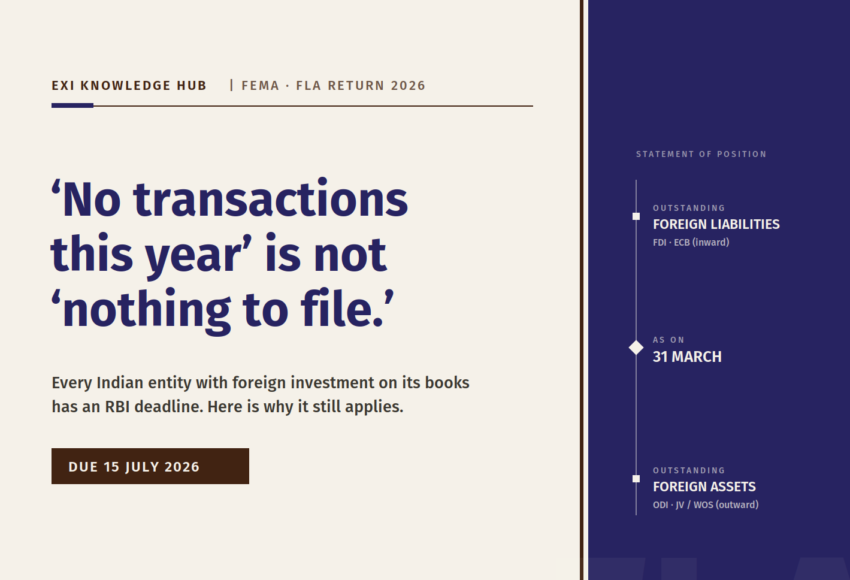
The FLA Return: Why “No Transactions This Year” Is Not the Same as “Nothing to File”
Every Indian entity with foreign investment on its books has an RBI deadline on 15 July. Here is what it covers, why it matters, and how to file it without the last-minute scramble.
A company raised foreign capital four years ago. One round, one overseas investor, a clean cap table. Since then, nothing has moved: no new allotment, no fresh remittance, no buy-back. When July comes around, the finance team files the income-tax return, closes the GST filings, and moves on. Nobody files the FLA return, because on paper there was “no foreign transaction this year.”
That single assumption is one of the most common, and most expensive, misreadings in Indian cross-border compliance. The FLA return is not triggered by what you did during the year. It is triggered by what still sits on your balance sheet on 31 March. And for most entities that have ever taken foreign money or invested abroad, something is still sitting there.
What the FLA return actually is
The Foreign Liabilities and Assets (FLA) return is an annual filing to the Reserve Bank of India under the Foreign Exchange Management Act, 1999, notified through A.P. (DIR Series) Circular No. 45 dated 15 March 2011. It is filed online through the RBI’s FLAIR portal (flair.rbi.org.in), and it captures a position, not a transaction: your outstanding foreign liabilities (inward investment, such as FDI and certain external borrowings) and your outstanding foreign assets (outward investment, such as ODI in overseas subsidiaries and joint ventures) as they stand on 31 March each year.
The RBI is not collecting this data for record-keeping alone. FLA numbers feed directly into India’s Balance of Payments, its International Investment Position, and the IMF’s Coordinated Direct Investment Survey. Your entity’s single return becomes one data point in the national picture of how much the world owns in India and how much India owns abroad. That is why the obligation works as a census: applied uniformly, with no minimum threshold to exempt small holdings.
Why “no transactions” does not release you
Here is the rule that catches people. If, as on 31 March, your entity has any outstanding FDI in India or any outstanding ODI abroad, you must file, even if not a single rupee of foreign money moved during the year. An investment made in an earlier year remains a foreign liability until it is fully repatriated, redeemed, or the investor exits. Downstream investment counts too: where a foreign investor holds an Indian entity through another Indian entity, that holding is still foreign investment for FLA purposes.
The obligation is also entity-agnostic. Companies, LLPs, partnership firms, SEBI-registered AIFs, and other resident entities all fall within it once they cross the FDI or ODI trigger. One useful negative to remember: share application money pending allotment is not treated as a foreign liability for FLA reporting until the shares are actually allotted.
The filings the FLA is constantly confused with
Much of the trouble around FLA comes from treating it as the same thing as other FEMA filings. It is not.
FC-GPR and the Single Master Form (filed on FIRMS) report individual transactions, such as a specific allotment of shares to a non-resident. The FLA reports the cumulative position on 31 March. One does not replace the other, and the RBI actively cross-checks them: if your FLA figures do not reconcile with your FC-GPR or ODI filings, expect a query.
The Annual Performance Report (APR) is different again. It applies only to entities with overseas joint ventures or wholly owned subsidiaries, is monitored by a separate RBI function, and falls due on 31 December. Filing your FLA does not discharge your APR obligation, and the reverse is equally true.
The timeline, and the part everyone gets wrong
For FY 2025-26, the FLA return reporting the position as on 31 March 2026 is due on 15 July 2026. The RBI extended last year’s deadline to 31 July, but an extension is a concession, not a schedule. Treat 15 July as the real date and any extension as a bonus.
The most useful thing to understand about the timeline is its two-step design. If your accounts are not audited by 15 July, you do not wait and you do not miss the deadline. You file on provisional figures by 15 July, and then file a revised return on audited figures by 30 September. No separate RBI approval is needed for that revision. The mistake is to hold the return back “until the audit is done,” miss July entirely, and convert an administrative step into a FEMA contravention.
What non-compliance actually costs
The visible cost is the Late Submission Fee: Rs. 7,500 per delayed return, payable where you file late but before any enforcement action. That is the cheap outcome.
The real exposure sits under Section 13 of FEMA. A contravention can attract a penalty of up to three times the amount involved where it is quantifiable, or up to Rs. 2,00,000 where it is not, with a further Rs. 5,000 per day for as long as the default continues. Where a return is missed outright and never regularised, the matter can move to compounding before the RBI’s regional office, a process that typically runs six to twelve months and costs considerably more than the filing ever would have.
There is a quieter consequence that rarely appears in the penalty tables. FLA compliance sits inside your broader FEMA record. An open default, or figures that contradict your other filings, can slow or stall future inward and outward remittances while the AD bank and RBI wait for your reporting to be brought current. For a company mid-way through a funding round or an overseas acquisition, that delay is the expensive part, not the Rs. 7,500.
How to file it without the July scramble
Register early, not in July. First-time filers must register on the FLAIR portal and wait for RBI-issued credentials, and a Class 3 Digital Signature Certificate is required. Start four to six weeks ahead so a portal or DSC issue does not eat your deadline.
Use a permanent email. Every login sends an OTP to the registered email, and all RBI communication flows there. Use a durable, monitored mailbox, not one tied to a single employee who may leave. Note for this year: the RBI moved FLA communication to flareturn@rbi.org.in in April 2026, replacing the older surveyfla address.
File provisional, then revise. Build the two-step timeline into your calendar from the start: provisional by 15 July, audited revision by 30 September.
Reconcile before you submit, not after. Map your balance-sheet items to the FLA categories and check that your foreign equity, non-resident holding percentage, and loan positions agree with your FC-GPR, FC-TRS, and ODI filings. Convert foreign-currency values to USD using the RBI reference rate as on 31 March. Discrepancies are what trigger RBI queries weeks later.
Keep the acknowledgment. Download and store every filed return and its acknowledgment before you change entity details, deactivate an account, or hand over to a new team. If you ever need to file a missed earlier year, note that it requires RBI approval before you can submit it.
The bottom line
The FLA return looks like a small form, and for a well-prepared entity it is. The risk is never the complexity of the return; it is the assumption that it does not apply, or that it can wait for the audit. If foreign investment has ever touched your balance sheet and has not fully left it, 15 July is your date. The most reliable way to make it a non-event is to treat it as a scheduled position report: reconciled against your other FEMA filings, filed on provisional numbers early, and revised on audited numbers on time.
How EXI can help
At Exactitude International, we handle FLA filings as part of a connected FEMA compliance cycle, not as an isolated July task, so that your FLA, FC-GPR, FC-TRS, and ODI positions tell one consistent story to the RBI. If you would like help with FLAIR registration or with the preparation and filing of your FLA return, our team can take it end to end.


Leave a Comment