
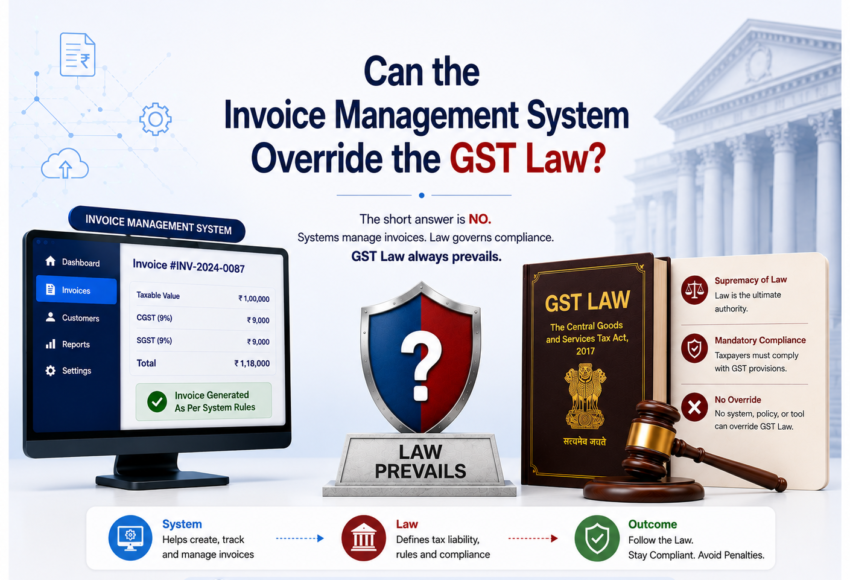
Can the Invoice Management System Override the GST Law?
The introduction of the Invoice Management System (IMS) marks another significant step in the Government’s journey towards invoice-level compliance and technology driven administration under GST. By enabling recipients to accept, reject or keep invoices pending before Input Tax Credit is reflected in their returns, IMS aims to improve reconciliation and reduce tax disputes.
However, as businesses begin using the system, certain practical situations have emerged that raise important legal questions. One such issue concerns the treatment of invoices issued purely due to clerical errors and the consequences of recipient actions within the IMS.
The question is fundamental: Can a procedural action taken on the GST portal create or sustain a tax liability where no taxable supply has ever taken place?
A Practical Scenario
Consider the following situation.
A supplier inadvertently issues a tax invoice due to a clerical or system error. No goods are supplied and no services are rendered pursuant to the invoice. Upon identifying the mistake, the supplier issues a corresponding credit note within the same tax period and reports both the tax invoice and the credit note in Form GSTR-1.
From a legal perspective, the transaction stands completely reversed. Since no supply has occurred, one would ordinarily expect that no GST liability survives.
However, difficulties may arise where the recipient rejects the credit note through the Invoice Management System while taking no corresponding action on the original invoice.
In such circumstances, the GST portal may continue to reflect the original invoice for tax purposes, potentially resulting in an additional tax liability for the supplier despite the absence of any underlying taxable transaction.
Levy of GST Depends Upon the Existence of a Supply
The foundation of the GST law is the levy provision contained in Section 9 of the CGST Act. GST is imposed on the supply of goods or services. Consequently, the existence of a taxable supply is the primary condition for the levy of tax.
Where no supply has actually taken place, the mere issuance of an invoice due to a clerical or inadvertent error does not, by itself, create a taxable event. If the error is identified and corrected through a valid credit note in accordance with the statutory provisions, the transaction ought to be examined on the basis of its true legal character rather than merely its reflection on the GST portal.
Purpose of a Credit Note
Section 34 of the CGST Act specifically permits a supplier to issue a credit note where the taxable value or tax charged exceeds what ought to have been charged or where other circumstances require correction of the original invoice.
The legislative objective is to enable genuine corrections in commercial documentation and ensure that the tax liability ultimately reflects the actual transaction undertaken by the parties.
Where an invoice has been issued entirely by mistake and no supply has materialised, the issuance of a corresponding credit note serves to reverse the erroneous documentation.
Can Recipient Action Under IMS Determine Taxability?
This is where an important legal question emerges.
IMS is undoubtedly an important compliance mechanism designed to improve invoice matching, facilitate reconciliation and strengthen the integrity of the GST ecosystem.
However, the statutory provisions governing levy, valuation, invoicing and tax liability are contained in the CGST Act and the Rules framed thereunder.
The role of the technology platform is to operationalise those statutory provisions. It is not intended to independently determine whether a taxable supply exists or to create a tax liability where the charging provisions of the Act are not attracted.
If the recipient’s rejection of a credit note were to automatically result in a continuing tax liability for the supplier despite the admitted absence of any supply, an important question arises as to whether such an outcome would be consistent with the scheme of the GST law.
Technology Must Operate Within the Statutory Framework
The increasing reliance on automated compliance systems undoubtedly enhances transparency and reduces revenue leakage. Nevertheless, technology cannot be viewed in isolation from the legislation it seeks to implement. Digital compliance tools are intended to facilitate statutory compliance, not to enlarge the scope of the charging provisions or alter substantive legal rights.
Where the legal position and the system-generated outcome diverge, the resolution must ultimately be found within the framework of the statute rather than the functionality of the portal.
Practical Challenges for Businesses
The issue has significant practical implications for suppliers. Businesses may face situations where:
- invoices are generated inadvertently due to clerical or system errors
- credit notes are issued within the same tax period to reverse such mistakes
- recipients reject or fail to act upon the credit notes in IMS
- system-driven tax computations potentially continue to reflect a tax liability despite the absence of any supply
Unless appropriate procedural safeguards are introduced, such situations may result in avoidable disputes and unnecessary litigation.
The Need for Regulatory Clarity
As the GST framework increasingly moves towards technology driven compliance, greater certainty is required regarding the legal consequences of actions performed within the Invoice Management System.
Clarification from the Government would be welcome on issues such as:
- the treatment of invoices issued due to genuine clerical or system errors
- the effect of recipient rejection of corresponding credit notes
- whether system validations can override documentary evidence demonstrating that no supply has taken place
- the manner in which suppliers may seek correction where portal behaviour does not accurately reflect the underlying transaction
Such guidance would help ensure that technological processes remain aligned with the statutory architecture of GST.
Conclusion
The Invoice Management System represents an important advancement in GST compliance and is expected to significantly improve invoice reconciliation and Input Tax Credit administration. However, the effectiveness of any technology driven framework ultimately depends upon its consistency with the governing legislation.
Where no taxable supply has taken place and an erroneous invoice has been duly reversed through the statutory mechanism, the resulting tax consequences should continue to be determined by the provisions of the CGST Act rather than by procedural actions on the portal alone.
As IMS continues to evolve, maintaining the balance between technological efficiency and legal certainty will be essential to preserving the foundational principles of the GST regime.


Leave a Comment