
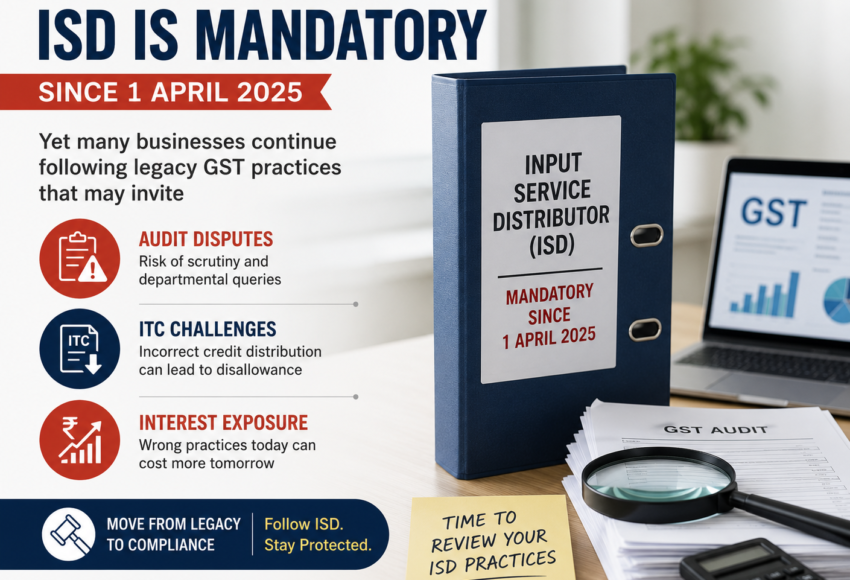
Mandatory Doesn’t Mean Optional: Why Many Businesses Are Still Getting ISD Wrong
More than a year has passed since the mandatory Input Service Distributor (ISD) framework became effective from 1 April 2025. Yet, a significant number of businesses continue to follow practices that were permissible under the earlier regime, exposing themselves to avoidable GST risks.
Many organisations are still adopting one of the following approaches:
- Availing the entire Input Tax Credit relating to common input services at the Head Office and utilizing the credit against its own outward tax liability without distributing it to other registrations.
- Distributing common input service credits through the cross-charge mechanism instead of the mandatory ISD route.
- Assuming that obtaining an ISD registration remains optional.
These practices were common under the earlier legal framework. However, following the amendments introduced by the Finance Act, 2024, the legal position has changed significantly.
The Shift from Optional to Mandatory
Prior to 1 April 2025, obtaining an ISD registration was optional. Businesses could either obtain an ISD registration for distribution of common input service credits or, in appropriate cases, adopt the cross-charge mechanism depending upon the nature of the transaction.
With effect from 1 April 2025, the law now mandates that Input Tax Credit relating to common input services received by one office on behalf of multiple GST registrations of the same legal entity must be distributed through the ISD mechanism.
The legislative intent is to establish a uniform and transparent framework for allocation of common service credits among distinct persons registered under GST.
Common Practices That May No Longer Be Sustainable
Despite the amendment, many businesses continue to accumulate common service credits at the Head Office, particularly where the Head Office generates substantial taxable turnover.
Common examples include credits relating to:
- ERP and software licences
- Audit and consulting services
- Legal and professional fees
- Brand promotion and advertising
- Corporate insurance policies
- Group-wide IT services
- Shared administrative services.
Instead of distributing these credits through ISD, businesses often utilise the entire ITC in the Head Office merely because sufficient output tax liability exists there. From 1 April 2025 onwards, this approach may not align with the amended statutory framework where such services are received for the benefit of multiple GST registrations.
Can Cross Charge Replace ISD?
Another misconception gaining traction is that businesses can continue distributing common input service credits through cross charging.
It is important to appreciate that cross charge and ISD operate in different legal spheres.
An ISD distributes Input Tax Credit of common input services received from third-party vendors.
A cross charge, on the other hand, applies where one distinct person supplies goods or services to another distinct person under Schedule I of the CGST Act.
The two mechanisms are therefore not interchangeable.
Where the law specifically requires common input service credits to be distributed through ISD, adopting cross charge merely as an alternative method of passing on the credit may invite departmental scrutiny.
Why This Matters
The objective of the amended ISD framework is not merely procedural. The Government intends to ensure that common input service credits are allocated to the GST registrations that actually consume those services rather than being concentrated in a single registration based on commercial convenience or output tax availability.
Consequently, businesses that continue following legacy practices may face questions during GST audits regarding:
- Incorrect availment of ITC at the Head Office.
- Failure to distribute common credits through ISD.
- Incorrect utilisation of common service credits.
- Adoption of cross charge where ISD was the prescribed mechanism.
- Interest and other consequential proceedings arising from incorrect credit allocation.
Immediate Action Points for Businesses
Businesses operating through multiple GST registrations should undertake an immediate review of their credit distribution practices. Particular attention should be given to:
- Identifying common input services received for multiple registrations.
- Obtaining ISD registration wherever applicable.
- Segregating common service credits from location specific credits.
- Reviewing existing cross-charge models to ensure they are being used only where legally appropriate.
- Aligning ERP systems and internal accounting processes with the mandatory ISD framework.
Early corrective action can significantly reduce future litigation and compliance costs.
Conclusion
The amendment effective from 1 April 2025 represents a fundamental shift in the GST credit distribution mechanism. What was once an optional compliance framework has now become a statutory requirement for distribution of common input service credits.
Businesses should therefore revisit long standing practices of retaining common ITC at the Head Office or relying exclusively on cross charges for credit allocation. While those approaches may have been commercially convenient under the earlier regime, they may no longer withstand scrutiny under the amended law. As GST enforcement increasingly becomes data driven, organisations should ensure that their credit distribution policies reflect not only operational convenience but also the statutory framework governing Input Service Distributors. A timely compliance review today can help avoid significant disputes, interest exposure and litigation tomorrow.


Leave a Comment