
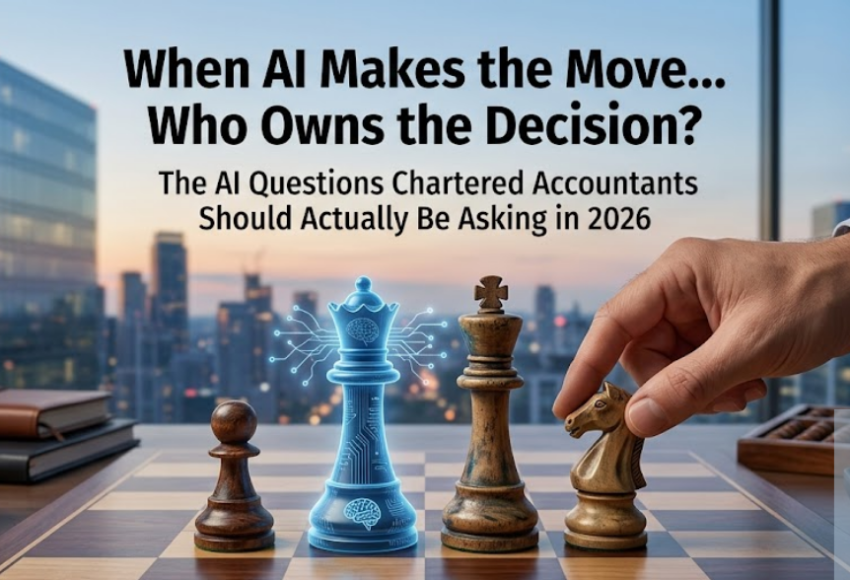
The AI Questions Chartered Accountants Should Actually Be Asking in 2026
If an AI tool can now scrutinise one hundred percent of a client’s ledger in the time it takes to pour a coffee, what exactly is the client paying the Chartered Accountant for?
That question is uncomfortable, and it is the right place to start. For most of the last two years the profession has reassured itself with a comforting line: AI will not replace Chartered Accountants, but Chartered Accountants who use AI will replace those who do not. It is true enough. It is also, by the middle of 2026, no longer the interesting question. Almost everyone is using AI now. The slogan has quietly stopped being a differentiator and become the baseline.
The harder questions sit underneath it, and they are the ones worth losing a little sleep over.
Where the Profession Actually Stands in 2026
This is no longer a debate about a future that might arrive. It has arrived, and the institutions have moved.
The Institute of Chartered Accountants of India has put its full weight behind adoption. Its AI Innovation Summit in June 2026 drew more than four thousand delegates to Bharat Mandapam, and ICAI reports having trained over fifty thousand members and built more than one hundred and fifty GPT based tools for professional use, alongside its AICA certification programme, now in its advanced third level. The revised Code of Ethics, effective from 1 April 2026, formally recognises artificial intelligence as part of the management and consultancy services a member may offer. AI is no longer a side skill. The regulator of your own profession now treats it as core competence.
The regulators of your clients have moved too. SEBI’s Responsible AI and Machine Learning framework brings model governance, audit trail retention and periodic AI disclosures into the compliance perimeter of regulated entities, which means their auditors inherit new procedures from the FY 2026-27 season. NFRA has begun testing AI in its own oversight of audit quality, describing it as early steps toward analysing far more financial statements, and far more closely, than a human team ever could. At the national level, the India AI Governance Guidelines set a Do No Harm principle and a framework of accountability, transparency and human oversight that will increasingly define what responsible use means in practice. The new financial statement format under Ind AS 118, aligned with IFRS 18, arrives into exactly this environment.
Globally, the picture is messier and worth noting. As of the middle of 2026 there is still no binding PCAOB or SEC standard governing the use of AI inside an audit. Firms are running full population testing and drafting disclosures with generative tools inside a genuine regulatory grey zone, even as the SEC has started asking about AI governance in its comment letters. India, in other words, is moving faster on structure than much of the West. That is an opportunity for firms that take governance seriously, and a trap for those that assume the absence of a rule means the absence of a risk.
The Questions Worth Worrying About
Set aside will AI replace me. Here are the five that matter.
1. What happens to the price of compliance work when a machine does it in minutes?
The threat to most practices is not unemployment. It is margin. When routine reconciliation, ledger scrutiny, standard drafting and first pass analysis can be done by tools your client can also buy, the market rate for that work falls. The firms that suffer are those whose revenue is concentrated in exactly the work AI does best. The question is not whether you can do the work faster. It is whether you can still charge for it, and what you will sell instead.
2. Who is accountable when AI is in the workpapers and it is wrong?
An AI tool can invent a citation, misclassify a transaction or produce a confident and incorrect number. When that output finds its way into a signed report, the accountability does not sit with the vendor. It sits with the member. Peer review, engagement documentation and the emerging expectation that firms record how AI was used in a file all point the same way. The signature still carries the liability. That has not changed, and it will not.
3. If AI does the junior work, who trains the next generation?
The economics of a CA firm have always rested on a pyramid. Articles and juniors do the groundwork, learn the craft by doing it, and grow into the seniors who exercise judgement. AI is very good at precisely the groundwork that used to be the training ground. If the base of the pyramid is automated away without a deliberate plan to build judgement in its place, firms risk producing a generation who can supervise AI but were never taught to be sceptical of it. This is a structural problem, not a software problem.
4. Are you using governed AI, or shadow AI?
The most immediate risk in most practices today is not strategic. It is a junior quietly pasting a client’s confidential trial balance into a free public chatbot to save an hour. Under the DPDP Act 2023 and basic professional confidentiality, that is a breach waiting to be discovered. The difference between a firm with sanctioned tools, a clear policy and an audit trail, and a firm where staff improvise with consumer tools, is the difference between an asset and a liability.
5. What is your value that a model cannot reproduce?
This is the question that answers the hook. A model can draft, calculate, summarise and search. It cannot take responsibility. It cannot sit across from a promoter and deliver a hard truth. It cannot exercise genuine professional scepticism, weigh materiality against context, or stake its own name on a judgement. The Chartered Accountant’s durable value was never the arithmetic. It is the judgement, the ethics, the accountability and the relationship. AI raises the price of everything it cannot do.
Recommendations: a practical guide
Do
- Treat AI as core professional competence, not an optional gadget. Complete a structured certification and require your team to do the same.
- Adopt sanctioned tools with a written AI use policy and keep an audit trail of where and how AI touched each engagement.
- Move the billing conversation away from time spent on routine work and toward judgement, advisory and outcomes.
- Verify everything. Treat each AI output as a first draft by a fast, confident junior who must be reviewed.
- Invest deliberately in building judgement in your juniors, precisely because AI has removed the tasks that used to build it.
- Keep client data inside governed, ideally India hosted or private, environments that respect DPDP obligations.
Don’t
- Do not paste confidential client information into public AI platforms. Ever.
- Do not let AI output reach a signed report, filing or opinion without professional review.
- Do not assume the absence of a binding standard means the absence of liability. The signature is yours.
- Do not compete on the price of commoditised compliance. You will lose to a subscription.
- Do not confuse fluency for correctness. AI is most dangerous when it is wrong and sounds right.
- Do not wait. Firms building capability and governance now are setting a bar the rest will struggle to reach.
The Real Question
The calculator did not replace the accountant. Excel did not either. AI will not replace the Chartered Accountant. But it is already redrawing the line between the work a professional is paid to do and the work a subscription now does for free.
So, the question is not whether AI will take your place. It is sharper than that. When the routine work is done in minutes and costs almost nothing, what will make a client choose you? Answer that clearly, build toward it deliberately, and AI stops being a threat and becomes the most capable member of your team.
At EXI, we help firms and finance leaders answer exactly that question, turning a fast-moving technology into a defensible advantage, with governance that stands up to scrutiny.
Where Excellence Meets Impact


Leave a Comment